The Hidden Price Tag of Custom Software: Why Your $10M App Is Just the Down Payment
.png)
When a tech-focused company signs off on a multimillion-dollar custom platform, the headline number is usually the build cost.
“We spent $10 million on our core application.”
What rarely makes the slide deck is the real number: what it costs to keep that platform alive, secure, and evolving over the next 10–20 years.
Industry data is remarkably consistent on one point: initial development is just the opening bid. Over a typical lifecycle, maintenance and support can cost 2–4× the original build, and in many cases 60–90% of total software lifecycle spend ends up in the maintenance bucket.1
Let’s unpack what that means in practice, using a $10M core application as an example.
The Rule of Thumb: 15–25% of Build Cost Per Year
Across enterprise software, a common benchmark is:
Annual maintenance = 15–25% of the original development cost (per year).2
That “maintenance” bucket usually includes:
- Production support and bug fixes
- Security updates & patching
- Performance tuning & scalability work
- Minor enhancements and UX tweaks
- Platform & library updates (OS, cloud services, frameworks)
For a $10M custom system, a “healthy average” planning number might be:
- Year 1–3: ~18% of build cost per year
- Year 4–10: ~22% per year as complexity grows
- Year 11–15: ~28% per year as the stack ages
- Year 16–20: ~35%+ per year for a legacy platform under strain
Those percentages aren’t random: they reflect two forces:
- Normal lifecycle maintenance (users want more, platforms change).
- Technical debt compounding over time.
How Technical Debt Turns Into Real Dollars
Technical debt is the extra cost you pay later because of shortcuts taken earlier—rushed features, weak test coverage, aging libraries, or “temporary” hacks that never got cleaned up. Over time, that debt compounds.
Studies show that:
- Organizations with high technical debt spend ~40% more on maintenance and deliver new features 25–50% slower than peers.3
- Technical debt drives higher maintenance effort, brittleness, and reduced innovation – like paying interest on a very bad credit card.4
In practice, that means:
- Every new feature is harder to build (“spaghetti code tax”).
- Regression risk grows, so testing and QA effort balloon.
- More defects escape to production, causing firefighting and outages.
- Upgrades to frameworks, databases, and cloud services become multi-month projects instead of routine chores.
The result: maintenance percentages creep up over time.
A 20-Year View: $10M Build, What Do You Really Spend?
Let’s walk through an illustrative scenario for a $10M core platform.
We’ll use conservative but realistic maintenance percentages aligned with industry norms:
- Years 1–3: 18% of build cost per year
- Years 4–10: 22% per year
- Years 11–15: 28% per year
- Years 16–20: 35% per year
Annual Support Spend (Illustrative)
10-Year Horizon
Over the first 10 years:
- Years 1–3: 3 × $1.8M = $5.4M
- Years 4–10: 7 × $2.2M = $15.4M
- Total maintenance (10 years): $20.8M
Add the original build:
- Total cost of ownership (TCO, 10 years) ≈ $30.8M
- That’s ~3.1× the original $10M build.
This aligns with modern life cycle analyses showing maintenance can reach 60–70% of total software cost over time.5
20-Year Horizon
Extend the same pattern out to 20 years:
- Years 1–3: 3 × $1.8M = $5.4M
- Years 4–10: 7 × $2.2M = $15.4M
- Years 11–15: 5 × $2.8M = $14M
- Years 16–20: 5 × $3.5M = $17.5M
Total maintenance (20 years): $52.3M
Add the original build:
Total cost of ownership (TCO, 20 years) ≈ $62.3M
So a platform that costs $10M to build can easily cost $50M+ to maintain over a long lifecycle, especially if technical debt is allowed to accumulate.
Visualizing the Cost Curve
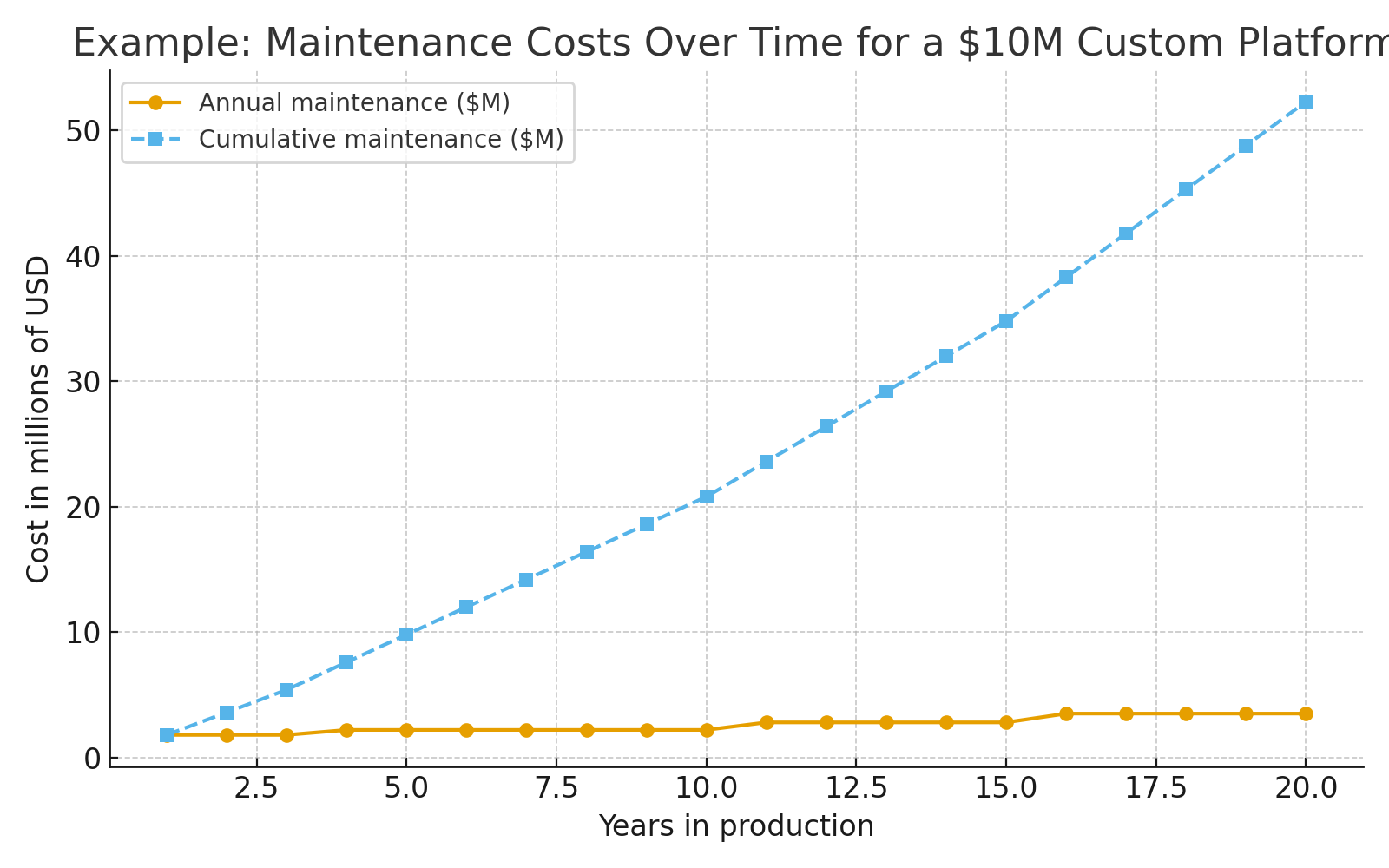
Figure 1 – Annual and cumulative maintenance costs for a $10M custom platform.
Maintenance starts at ~$1.8M per year and climbs above $3.5M per year by year 20, with cumulative maintenance spend surpassing $50M.
When Does a Full Rebuild Start to Make Sense?
Eventually you hit a tipping point where every new feature feels like surgery on a 90-year-old patient. Some common signals:
- Change cost explodes
- Simple feature requests require months and cross-team coordination.
- Teams report that “touching anything breaks everything.”
- Simple feature requests require months and cross-team coordination.
- Talent and tooling drift
- Your stack or frameworks are no longer mainstream.
- Hiring engineers who actually want to work on it becomes difficult.
- Your stack or frameworks are no longer mainstream.
- Vendor and platform end-of-life
- Key components (DB, runtime, OS, 3rd-party libs) are end-of-support.
- Security teams push for upgrades that require large-scale refactors.
- Key components (DB, runtime, OS, 3rd-party libs) are end-of-support.
- Maintenance vs. innovation imbalance
- More than 70–80% of engineering time is consumed by maintenance, bug fixing, and firefighting, with little capacity left for new value.3
Financially, you can frame the rebuild decision like this:
- If you expect to spend another $20–30M over the next 7–10 years just to keep a creaking system alive…
- …and a modern rebuild would cost, say, $12–15M with much lower maintenance percentages afterward…
then the rebuild starts to look like a rational investment, not a vanity project.
Practical Budgeting Rules for Tech-Focused Companies
If you’re a CFO, CTO, or founder planning a large custom build, here are some pragmatic rules of thumb:
- Treat the build as 20–40% of lifetime cost
- Expect the remaining 60–80% to be maintenance, enhancements, and operations.6
- Budget 15–25% of build cost annually from day one
- Lock this into your financial model for the first 5–7 years.
- Lock this into your financial model for the first 5–7 years.
- Actively manage technical debt
- Allocate a fixed percentage of sprint capacity (10–20%) to refactoring, test coverage, and platform upgrades.
- Track debt like financial liability, with visibility in roadmaps and steering committees.
- Allocate a fixed percentage of sprint capacity (10–20%) to refactoring, test coverage, and platform upgrades.
- Measure the maintenance/innovation ratio
- Regularly measure what percentage of engineering time goes to “keep the lights on” vs. new value.
- When maintenance time consistently exceeds, say, 60–70%, you’re entering “legacy drag” territory.
- Regularly measure what percentage of engineering time goes to “keep the lights on” vs. new value.
- Define explicit rebuild triggers
- Example triggers:
- 2–3 major core components are EOL with no safe upgrade path.
- Regulatory or security requirements can’t be met without massive rework.
- The cost of adding new strategic capabilities is repeatedly higher than an equivalent greenfield effort.
- 2–3 major core components are EOL with no safe upgrade path.
- Example triggers:
Bottom Line
For a tech-focused company, spending $10M on a core application is not a one-time event. It’s the entry ticket to a $30–60M, decade-plus commitment.
Handled well—with disciplined investment in quality and technical debt management—you get a platform that compounds value: faster delivery, happier users, and a cleaner path to modernization.
Handled poorly, you end up servicing an ever-growing “interest payment” on technical debt, spending more to stand still while competitors ship faster on modern stacks.
The smartest move isn’t to avoid that $10M build. It’s to go into it with eyes open, a realistic maintenance budget, and a clear plan for when it’s time to pay down debt—or start fresh.
1 Teaching Agile - Software Maintenance: Types, Process, Cost & Best Practices
2 ScienceSoft - SoftwareMaintenance and Support
3 Full Scale - Technical Debt Quantification—It’s True Cost for Your Business
4 Software Improvement Group - Technical debt and its impact on IT budgets
5 Geeks For Geeks - Cost and efforts of software maintenance
6 Iotric - Software Maintenance Cost: Key Factors and Insights You Need to Know
.png)


The Hidden Price Tag of Custom Software: Why Your $10M App Is Just the Down Payment


We believe there is always a more efficient way
Thinklogic has a strong history of successfully developing and bringing to market hundreds of new web-based custom software applications. From concept refinement and business planning, to technology deployment and selling to the end-user, our team has expertise in both technology and marketing.

Innovative Developers
We understand how to build custom solutions fit for the digital age.

Clean and Concise
We want to deliver our message as quickly as possible, without any unnecessary flare.

Business-minded
Creating value for your business is our number one priority - we mean business.


We build mission-critical web solutions for businesses looking for digital transformation.


.svg)
Work inquiries
Stay in touch
Accessibility: If you are vision-impaired or have some other impairment covered by the Americans with Disabilities Act or a similar law, and you wish to discuss potential accommodations related to using this website, please contact our Accessibility Manager at (310) 337 6646


